InterviewFlying ObjectMatt O'Brian
Interview: Matt O'Brian, Flying Object Songwriter
In an hour-long Pulse of Ithaca Podcast episode recorded the night before a Deep Dive show, the Rochester songwriter walks through the reggae years, the abrupt exit, eight years as a singing drummer and a new record called Homesick.
by
May 25, 2024
Editor’s note: This interview was recorded and published in 2024. Matt O’Brian has since rejoined Giant Panda Guerilla Dub Squad for the band’s 2026 tour.
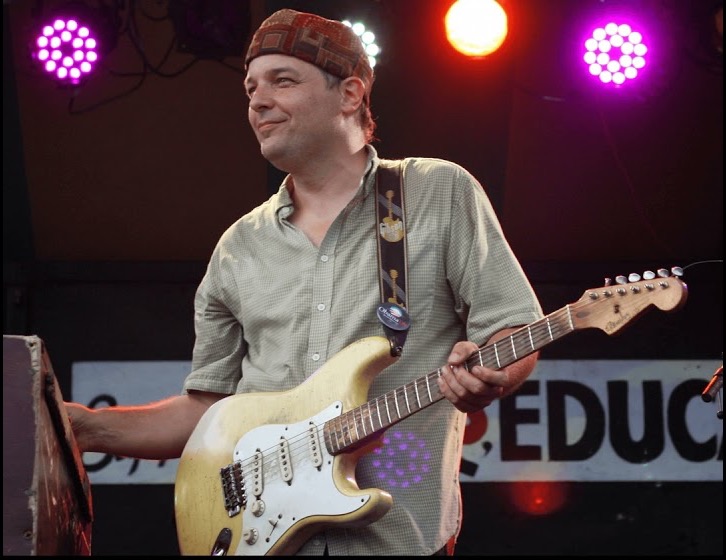
ITHACA, N.Y. — Rochester songwriter Matt O’Brian, a co-founder of Giant Panda Guerilla Dub Squad and later the singing drummer in Thunder Body, sat for an hour-long interview with the Pulse of Ithaca Podcast, recorded the night before his current band Flying Object opened for Bumping Uglies at Deep Dive in Ithaca on Thursday, February 8, 2024.
In it, O’Brian discusses the night he left Giant Panda, which he says he has never talked about publicly. “People still to this day ask me about Panda,” he said. “I don’t think it’s ever been discussed anywhere.” Asked directly, he answered, then said he could not get into all of it.
The conversation runs roughly forty minutes inside a sixty-two minute episode, which also covers the Ithaca Reggae Fest lineup and a hike in Danby State Forest. Episode 11 was posted to the show’s YouTube channel on May 25, 2024, and is embedded in full below.
A drum set, a guitar and a five-year-old
O’Brian traces the whole thing to a single year in his childhood, when his father brought home a drum set and, shortly after, an acoustic guitar. He was five.
"Nothing had ever made me so excited, and I'm still that excited."
Matt O'Brian
The follow-up was a Beatles hits record and the soundtrack to the film “Imagine.” “I was like, okay, I know what we’re doing now,” he said.
His father played drums, though O’Brian describes the style narrowly. “He was good, but he was like a country drummer, strictly,” he said. “Everything he played sounded like country music.” The guitar came with a routine: his father would write a song, sit O’Brian on his lap and ask him what he thought the words should be.
His younger brother, drummer Chris O’Brian, grew up in the same room with the same instruments. The two have played together since at least high school.
Reggae first, and on purpose
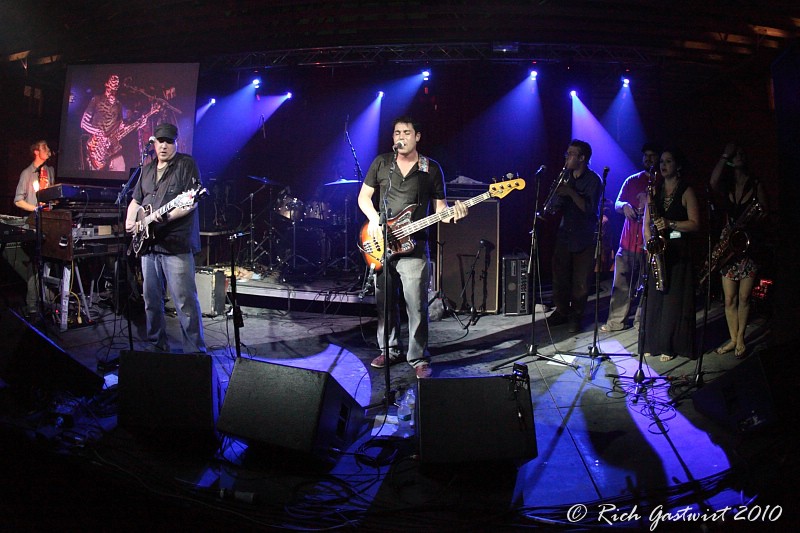
Giant Panda Guerilla Dub Squad formed in Rochester in 2001, when the O’Brian brothers teamed up with childhood friend James Searl on bass and vocals. O’Brian describes the band’s early years as deliberate to the point of severity.
“We were really hardcore about doing a very good job with that music, which of course we considered very sacred and hallowed ground, and we needed to be treading thoughtfully,” he said.
The decision that shaped everything after it was to commit to reggae rather than to fold it into something else. “The full commitment to do reggae and be reggae first was a specific decision,” he said. Left alone, he thinks the band would have drifted somewhere else entirely.
“Inevitably we would have been playing some kind of funky, groovy music that was intended for people to dance to, and that at the time in our lives would have probably taken the shape of a jam band,” he said.
Dub as the place the jam was allowed to live
Panda’s live shows in that era stretched songs well past ten minutes, layering long dub passages over the roots material. O’Brian says dub was what made that possible without breaking the band’s own rule.
"Dub gives you the platform to be like, well, we're going to call the jamming dub, and we're going to serve the groove way more than we serve the virtuosic playing of instruments."
Matt O'Brian
He was the band’s guitar player then, and says the solos were never the point. “I could do a big guitar solo or whatever, but it was really about what layer that was on a groovy palette,” he said.
The band worked at a volume that blurs the memories. O’Brian puts the pace at “like 150 gigs a year or something like that,” which is why he tends to disappoint people who ask him to confirm a specific night. Two he does hold onto. One is Red Rocks, opening a reggae festival. The other is Club Infinity outside Buffalo, a room he remembers as a country square dance bar most of the week that decided to start booking concerts anyway.
“All of a sudden this town sixty miles from our hometown, which we just hadn’t done very much, was a thing,” he said.
This site covered that run. Giant Panda played its first Buffalo show at Club Infinity on September 13, 2008, and closed out 2010 in the same room on December 11.
The night that turned out to be the last one
O’Brian left Giant Panda abruptly, alongside keyboard player Rachel Orke. He does not soften the account.
“We were fried,” he said. “We all were uniformly fried. We were doing what I thought from the middle of the stage was a very good job, and we were young, and everything was all built up.”
There was no farewell show. “The night I played my last Panda show wasn’t a planned thing,” he said, and connects it to a phrase his current band uses as a running joke, taken from the name of a Flying Object show: you never know when it’s the last hang.
Asked what happened, he declined to go into specifics and took the blame for his own part in it.
"I was all wound up back then, man. At the time that happened I don't have anything good to say about my conduct toward my bandmates, or anything like that day or the surrounding days."
Matt O'Brian
He says the split was never really about a single incident so much as a disagreement about direction that only became clear afterward. Panda had been touring successfully with West Coast reggae acts whose sets were “a lot more straightforward and simple and catchy and poppy,” played close to the same way every night, and some of the band saw a working model in that.
“I kind of stumbled into doing what we were doing,” he said. “We didn’t know anything about what other people think about how you’re supposed to do it, and I think we should keep doing what we are trying to do.”
He is careful to leave the band its own credit. “Panda has been Panda since then, does what they do,” he said. “You can see that they want to be doing it the way they’re doing it.”
He also says the aftermath he braced for never arrived, and that the relationship survived it. “I love these dudes now,” he said. “I thought everyone in the whole world would ask, and I’m so glad they didn’t.” He has since joined them onstage as a guest.
Thunder Body, and an accident at the drum kit
O’Brian and Orke started Thunder Body next. It became the longer chapter of the two. By his own count he appears on two Panda records, a live album and the 2006 debut “Slow Down,” against roughly five Thunder Body recordings, one of which was still unreleased at the time of the interview.
“The people in Thunder Body were the exact people we would have wanted to wind up with,” he said. “They’re creative lunatics, and they’re really, really good friends to this day.”
He had intended to make a statement on guitar. Drums were an accident. The percussionist lined up to drum for Thunder Body, a former Panda member from the era when the band carried heavy percussion, moved to Tennessee before it got going and handed the seat to a Rochester drummer he knew. When that drummer missed a rehearsal, O’Brian sat down at the kit himself.
Guitarist Dennis Mariano told him to stay there. “He was like, you should just play drums,” said O’Brian. “Play drums and sing, in the band, for real.”
That arrangement held for roughly eight years, with O’Brian set up in the middle of the stage. “I liked doing that,” he said. “It was a little much.”
Flying Object, built around the songs
Flying Object began as a name O’Brian had been using privately for the material he was writing after Thunder Body. Twice it nearly did not happen. He assembled a version with a jazz trio out of the Eastman School of Music, “and we got two gigs in, and then covid hit.”
What restarted it was morning sessions in a Rochester rehearsal space with his brother and Mike Martinez, a photographer and videographer the brothers knew from work who also played guitar. The lineup sorted itself by elimination, which is how the band’s frontman ended up on bass.
“Mike Martinez likes to play guitar when we jam, my brother wants to play drums, so I had bass,” he said. “And I did not like it, because I was not good at it. I worked really hard on it, and I’m like, oh yeah, I’m a bass player now.”
The band tested itself by opening three nights for Giant Panda. On the third, Max Flansburg of Dirty Blanket sat in on guitar and never left.
“So then it was like, wow, we have Max in the band, and he’s like, wow, I get to be in your van,” he said.
O’Brian describes the whole project as the loosest of the three. Panda had a specific idea of what everything should be, and Thunder Body got to execute his own. “Flying Object, I’m like, somebody be in a van with me,” he said. Asked whether he has preferences for how the others play, his answer was no. “I write the songs, and as long as the songs come across, that makes me happy.”
Playing again with his brother is the part he returns to.
“What a waste, too bad we had to be so much older to have it be harmonious and perfect and inevitable, because it feels very, very good,” he said. “Musically we lock in in a certain way.”
He credits Chris with pushing the band into existence at all. “It was really my brother’s idea.”
Excavating a song rather than writing one
Asked about process, O’Brian describes something closer to retrieval than composition. Songs arrive already partly formed and the job is not to interfere with them.
“You’re just looking for a song,” he said. “That’s all I’m doing, is looking for a song, hoping one falls into my lap out of nowhere in the kitchen, and then I work on it.”
The test he uses is repetition: if a piece of music keeps recurring in his head unprompted, it is worth chasing. From there he treats it like a cover he has not heard properly yet. “Sometimes writing a song is similar to you’re learning a tune, but you don’t know how it goes yet,” he said.
"There might be a whole pyramid buried underneath the song. You know for sure that it's a pyramid because it's a big tip with four sides. You don't have a laser analysis system to see what's going on underneath, but you do know that if you keep at it and move the sand out of the way, you're going to see what's there."
Matt O'Brian
Lyrics come last and stay unwritten as long as possible. “I try to just stay out of the way till the day you know exactly what to say,” he said. “Don’t start thinking about what are the lyrics and writing them down, because then you’re stuck with whatever you put there.”
What he would tell a younger musician
Asked what advice he would give his younger self, O’Brian said it was the question he had thought about most before the interview. He gave two answers.
The first was mechanical. “Whatever you’re doing in between, just play piano more,” he said. “While you’re doing anything, at least have an instrument in your hand, because you’ll just be happy about that later. I promise.” He added a second clause to it: don’t paint yourself into any particular corner.
The second was not about music.
“Try harder to be better, mostly at the interpersonal stuff,” he said. “Take care of yourself and take care of the people around you. The people around you aren’t your little brother, and you can’t argue like your kids. This is your life now, and your career. Maybe treat everything around you with that type of reverence.”
He offered an open line to younger players listening. “I encourage those kids to send me a DM, because everything is a mystery,” he said. “I’ll tell you whatever you want to hear. Wide open book. Learn from my mistakes.”
A record called Homesick
Flying Object was half finished tracking its first album at the time of the interview, with four days of studio time budgeted in total and the remainder scheduled for early March 2024. The approach matches the band: play it live, overdub as little as possible.
“We just played, and if stuff is overdubbed it’s mostly somebody couldn’t be there,” he said. “We’re not doing much to it. It’s going to sound very similar to what you would expect if you’ve been following us.”
The record is titled “Homesick,” after its opening track, which O’Brian says functions as the band’s theme song without the band ever having framed it that way.
“The sentiment that song gets across is what we’re trying to find,” he said. “That’s where the Flying Object is going. You hope it’s going home.”
The Deep Dive show
The interview was recorded the night before Flying Object opened for Bumping Uglies, the Annapolis, Maryland band that blends reggae, ska and punk, at Deep Dive in Ithaca. O’Brian said the two bands had already agreed to share backline.
He was blunt about the band’s Ithaca history. “I went and played Flying Object before it was ready, mostly in Ithaca,” he said. “Every time I’d play Flying Object I’d be like, that’s a dud.” He said the current lineup has changed that, crediting Flansburg’s playing in particular.
“We have not been able to play as much as we want to play,” he said. “We are revved up.” The set was scheduled for forty-five minutes to an hour.
He closed on what the podcast itself was doing. “Keep doing it, keep asking questions, keep giving people the space, and then our community builds,” he said.
Watch the full episode on YouTube
The author co-hosts the Pulse of Ithaca Podcast and conducted this interview. Quotations are transcribed from the episode audio and lightly trimmed for filler. Speaker and band names have been corrected against published band listings where the automatic transcript garbled them.
Pulse of Ithaca Podcast, Episode 11, “Interview with Matt O’Brian of FLYING OBJECT,” running 1 hour and 2 minutes, recorded in Ithaca, New York, and published to the show’s YouTube channel on May 25, 2024. Flying Object opened for Bumping Uglies at Deep Dive in Ithaca, New York, on Thursday, February 8, 2024. Episode artwork from the Pulse of Ithaca Podcast.
Sources: Pulse of Ithaca Podcast, Episode 11, Pulse of Ithaca Podcast channel, Giant Panda Guerilla Dub Squad, Giant Panda Guerilla Dub Squad on Rootfire, Thunder Body on Rootfire, Max Flansburg of Dirty Blanket, Overhand Sam show listing, bandsthatjam.com archive, Giant Panda at Club Infinity, September 13, 2008.